
A billion dollars in empty warehouses, a 6,500-year-old fish and other things I’m looking at
ICE warehouses, ancient fish, border surveillance, the White House press pool, and a D.B. Cooper FOIA rabbit hole.


Today I’m looking at a man the United States deported to a country he had never heard of, a 6,500-year-old fish that border-wall crews drove through, and about $1 billion ICE spent on warehouses it now mostly wants to sell.
There’s also a fight over who gets to ride on Air Force One and, because the internet occasionally rewards bad decisions, a D.B. Cooper FOIA lawsuit.
He was deported to a country he had never heard of
Nicholas Casey has a terrific story in The New York Times Magazine about Roberto Mosquera, a 59-year-old Cuban man the United States deported to Eswatini, a tiny, landlocked country in southern Africa.
Mosquera came to the United States when he was 12, during the 1980 Mariel boatlift. As a teenager he joined a Miami gang. In his 20s he took a plea deal on an attempted murder charge after a 16-year-old rival was shot in the leg. Mosquera told Casey he wasn’t there that night. He served nine years. Cuba would not take him back, so immigration authorities held him for six more. He was released in 2002 under an agreement that let him stay and work in the United States as long as he checked in regularly with immigration authorities.
He did about three more years in jail after running from a traffic stop around 2009. Then he became a plumbing foreman and raised four daughters. By 2024, his sister told Casey, he was practically stumping for Donald Trump.
Then Trump returned to office.
In June 2025, Mosquera went to an immigration office to renew his work permit and was detained. He was held in Miami, then El Paso, then put on a small jet with four other men and moved to a U.S. military cargo plane in Djibouti. About 30 hours after leaving Texas, he stepped off in Eswatini. He had never heard of the country.
The men were taken to Matsapha Correctional Complex, a maximum-security prison. Mosquera had already served his criminal sentence in the United States. He has not been charged with a crime in Eswatini. More than a year later, Casey reported, he was still there, one of 19 men held in the prison.
Casey reached Mosquera and other deportees over WhatsApp, on a cellphone Mosquera was allowed to buy after a nearly monthlong hunger strike. The story gets at something the phrase “third-country deportation” tends to hide. The United States can put a man on a plane to a country where he has never lived and leave the question of what happens next to someone else.
Read Nicholas Casey’s New York Times Magazine story
We drove a bulldozer through a 6,500-year-old fish
The Las Playas Intaglio is a giant fish scraped into the desert south of Ajo, Arizona, on the ancestral homeland of the Tohono O’odham. It is more than 170 feet long and about 50 feet wide.
For years, archaeologists thought it was about 1,000 years old. New research using rock and soil samples puts it at least 6,500 years old, which makes it the oldest dated geoglyph of its kind in the Americas.
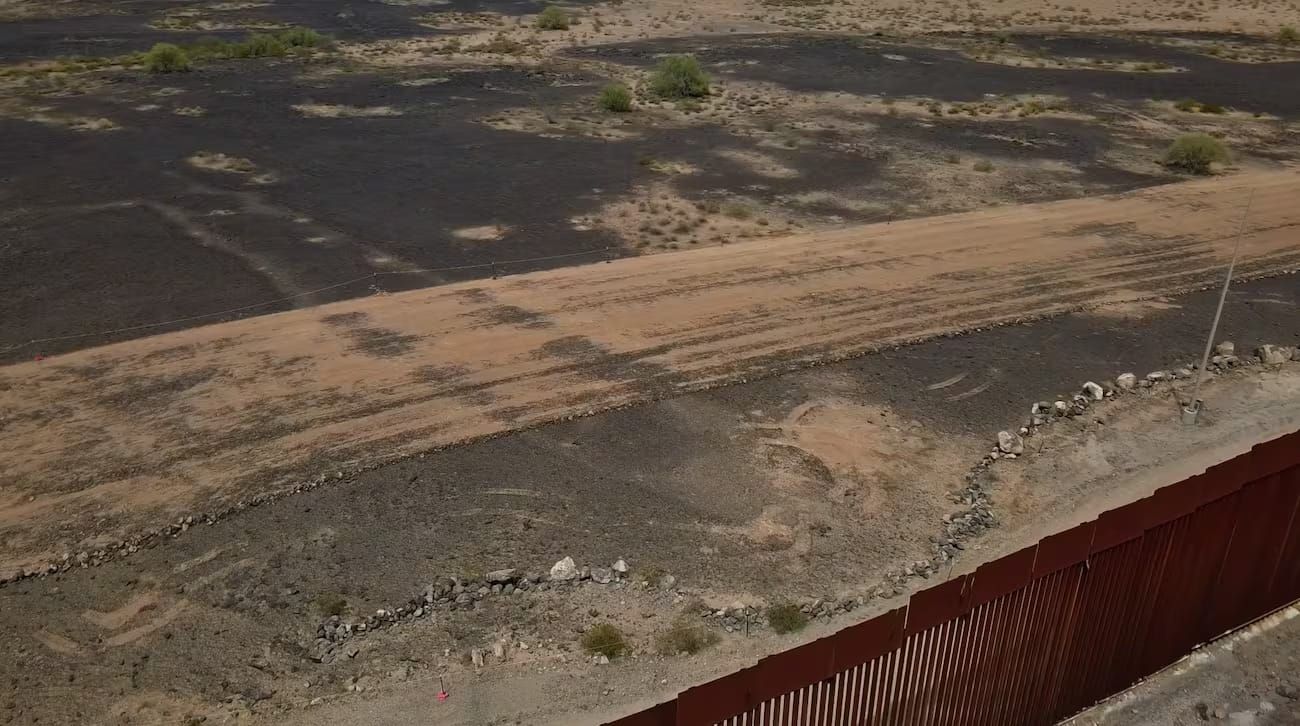
We learned this after border-wall construction had already gone through it. In April, federal contractors drove heavy machinery across the site and cut a roughly 50-foot-wide path through the geoglyph. Aerial images show the route crossing the fish.
There is something almost too neat about finding out an archaeological site is several thousand years older than anyone thought a few months after bulldozers drove across it.
Read AZFamily’s report on the new dating
Read KJZZ’s reporting from Arizona
Read "Las Playas Intaglio Damaged by Border Wall Construction Is Older Than 6,500 Years," by David S. Whitley and Ronald I. Dorn, on page 28 of the SAA Architectural Record — on page 28.
The wall is increasingly a surveillance system
The physical border wall gets most of the attention. I’m more interested in the technology going up around it.
Customs and Border Protection is buying autonomous surveillance towers that use cameras and algorithms to detect, classify and track people and objects.
In June, General Dynamics Information Technology announced that CBP had awarded it a $71 million task order for relocatable autonomous surveillance towers. The order can reach $115 million and sits under a larger CBP surveillance-equipment contract with a $1.8 billion ceiling. GDIT says the towers combine artificial intelligence with 5G and satellite communications. In April, CBP certified the system under requirements that autonomous surveillance systems use AI, machine learning, computer vision or similar algorithms to detect and track targets in real time.
This is the kind of thing we’re interested in with Dead Reckoning. The sales pitch is easy to find. I want to know what happens after the towers go up. How accurately do they identify people? How many false alarms do they produce, and what happens when the system gets something wrong? What does maintenance cost? Who has access to the data? How much public money ultimately goes into the system?
Read GDIT’s announcement of the CBP contract
Read about GDIT’s CBP certification
ICE bought 11 warehouses and now wants to sell seven
The Government Accountability Office released a report Thursday on ICE’s expansion of immigration detention.
Since January 2025, ICE has pursued six new detention-expansion initiatives. GAO found that the agency committed billions of dollars without the analysis and planning needed to figure out how much detention space it required, what kind it needed or what the options would ultimately cost.
The warehouses are the best example.
In December 2025, ICE began what it called the Detention Reengineering Initiative, a plan to open 24 warehouse facilities by November 2026. Between January and April, ICE bought 11 warehouses for about $1.07 billion.
In June, the Department of Homeland Security began reconsidering the warehouse model because, according to GAO, it had not done adequate due diligence and planning. ICE told investigators it was working with the General Services Administration to sell seven of the 11.
ICE paid $707 million for those seven. It also spent $7.7 million on costs it cannot recover, including zoning assessments and title insurance. By August, another $12.8 million had gone to utilities, security and other services at the empty buildings.
ICE is still spending on the warehouses it plans to keep. The agency obligated $113 million for renovations and operations at a warehouse in Hagerstown, Maryland, and $313 million for one in Surprise, Arizona. As of September, work at both was largely on hold because of lawsuits brought by the two states’ attorneys general.
Meanwhile, ICE changed strategies again. CBS News reported that in July and August the agency spent $2.2 billion buying four existing detention facilities from CoreCivic, the private prison company. ICE already pays CoreCivic to operate them. The government is buying the buildings from the company and then paying the company to keep running them.
This is pretty much the Dead Reckoning thesis compressed into a single government program. Follow the money. Find out what somebody promised and what the government bought. Then see what happened.
Read the full GAO report as a PDF
Read CBS News’ examination of the spending
Following the president to a football game
There is a serious press-freedom fight happening at the White House.
Trump banned CNN, MS NOW and Politico from White House grounds this month. The outlets sued, arguing that the government was retaliating against them for their coverage. Fox News, ABC News, CBS News and NBC News briefly stopped participating in the White House television pool in response. On Thursday, U.S. District Judge Timothy Kelly temporarily blocked the ban.
On Saturday, CNN was scheduled to handle television pool duties aboard Air Force One while Trump traveled to Knoxville for the Tennessee-Texas football game. The White House left CNN off the plane and brought Real America’s Voice, a conservative outlet that isn’t part of the network pool.
The constitutional fight matters. If a government is excluding reporters because it dislikes their journalism, news organizations should fight that.
I have a separate question about journalism itself.
The White House press pool exists for good reasons. Space around a president is often limited. A small group of journalists gets access and shares its reporting, video and audio with everybody else. Without independent journalists there, the public can wind up dependent on government-produced footage and government-controlled access.
But we’ve also built a journalism culture in which virtually everything a president does becomes an event requiring a small traveling industry of reporters.
Saturday’s destination was a college football game.
There are detention facilities reporters cannot enter. There are military programs almost nobody understands. Federal agencies can take years to produce public records. Billions of dollars move through government contracts with very little sustained coverage.
I’d like to see more reporters there.
Read AP’s explanation of the White House pool fight
Read about CNN being excluded from Air Force One
And somehow I ended up reading a D.B. Cooper lawsuit
In July 2016, the FBI stopped actively investigating D.B. Cooper.
The bureau had spent 45 years chasing the man who hijacked Northwest Orient Flight 305 in 1971, collected a $200,000 ransom and parachuted out of the plane somewhere between Seattle and Reno. Nobody has ever proved who he was.
The FBI said it had exhausted credible leads and would put its resources elsewhere. It left one door open. If someone turned up physical evidence tied specifically to Cooper’s parachutes or the ransom money, the bureau wanted to hear about it.
Two months later, television producer and investigator Thomas J. Colbert sued the FBI and the Justice Department under the Freedom of Information Act. He wanted records from the Cooper investigation, and his complaint said the FBI had failed to respond within the time FOIA requires. The case was filed in September 2016 in federal court in Washington.
There are few combinations of words more likely to destroy an afternoon than “D.B. Cooper FOIA litigation.”
So obviously I clicked.
Read the Colbert case docket and filings
Read the FBI’s 2016 announcement ending its active Cooper investigation
Hat tip to the sleuths of CourtWatch for resurfacing these D.B. Cooper docs. Follow them here.
That’s roughly where my browser tabs are today.
Today's song of the day is...
"Again," by Girl Tones.
Have anything to say? Reach me here: matt AT amphibian DOT media
Sign up for new work, reporting notes, show updates, and the useful parts of the process.